Hashtags can help content reach relevant conversations on X, but random or overloaded tags rarely solve a discovery problem. The challenge is finding Twitter hashtags that are relevant, active, and actually used by the audience you want to reach.
This guide covers a practical 5-step system to find the best hashtags for Twitter: audit tags before using them, research niche and community hashtags, build a reusable hashtag bank, apply a 0–2 hashtag rule, and review performance to refine your list.
Key Takeaways
- Relevance beats volume: Start with one or two hashtags that closely match the topic and audience.
- Research before using: Check recent posts and conversations on X to make sure a hashtag is active and relevant.
- Prioritize niche tags: Community-specific hashtags can be more useful than broad, crowded tags.
- Build a hashtag bank: Organize proven tags by content topic instead of researching from scratch for every post.
- Review and refine: Keep the hashtags that support discovery and engagement, and remove those that consistently add little value.
Do Twitter Hashtags Still Work in 2026?
Hashtags on X still categorize your posts and make them discoverable through search and topic pages. What they no longer do reliably is push your content to people who don't follow you — the timeline algorithm now leans on engagement signals (replies, reposts, bookmarks, watch time) and on semantic understanding of your post's text rather than keyword tags.
The platform itself has been signaling this shift for a while. In June 2025, X banned hashtags from ads, and in December 2024, Elon Musk said the system no longer needed them. Yet the tags remain genuinely useful in three situations:
- Niche communities — tags like #MarketingTwitter and #SmallBizTwitter are how specific audiences find each other and scan for content.
- Live events and trends — a timely tag plugs you into a real-time conversation while it's hot.
- Branded campaigns — a unique campaign tag gives you a measurable, searchable thread of your own content.
So the question isn't "do hashtags work?" It's "are you using the kind of hashtags that still work, in the way the platform rewards?"
One thing to keep in mind: Hashtags are a distribution layer, not a content strategy. A post that earns early engagement will travel further with the right tag. A post that doesn't earn engagement won't be saved by a tag.
How to Use Twitter Hashtags with 5 Steps
The five-step system takes about 30 minutes to set up, then a few minutes per week.
Step 1: Audit every tag before you use it
The fastest way to look spammy on X is copying a "top 100 hashtags" list from an old blog post. Most of those tags are dead, hijacked, or stuffed with bots. The audit takes 60 seconds and should be a non-negotiable habit.
- Open X search and type the hashtag. Look at what actually appears — not the first few promoted results, but the overall mix.
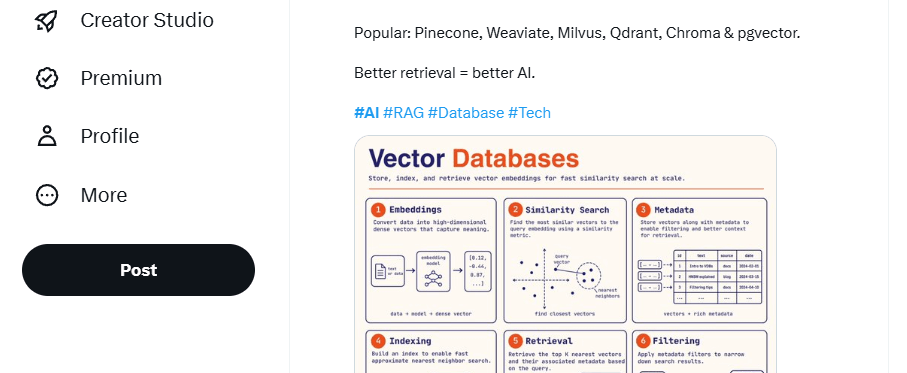
- Check recency. Switch to the "Latest" tab. If the most recent posts are days or weeks old, the tag isn't active. Active community tags get new posts within hours.
- Check quality. Scroll the top posts. Are they from real accounts with real engagement, or from bot farms posting links and reposting each other? A tag full of spam will drag your post down, not lift it.
- Check meaning. Tags get hijacked. #FollowFriday is a weekly ritual; a tag like #GrowthHacking may now be dominated by course-seller spam. Make sure the conversation matches your content.
- Check volume vs. competition. A tag with millions of posts means your content disappears instantly; a tag with a few hundred fresh posts in your niche can put you near the top of the topic feed.
⚠️ Warning: Some tags are effectively unusable because they're permanently flooded with spam or associated with scams. If a tag's search results embarrass you, don't put your brand next to them — no matter how popular the tag looks in a third-party tool.
Step 2: Collect candidates from four sources
Build your hashtag bank from four sources:
- X trends: Check Explore for relevant trending topics and hashtags.
- Niche accounts: Study five accounts one tier above you and note the hashtags used on their stronger posts.
- Community language: Track the tags your audience already uses, including niche communities such as #WritingCommunity or #SmallBizTwitter.
- Hashtag tools: Use RiteTag or GetDayTrends for additional volume and trend signals, but don't copy their suggestions blindly.
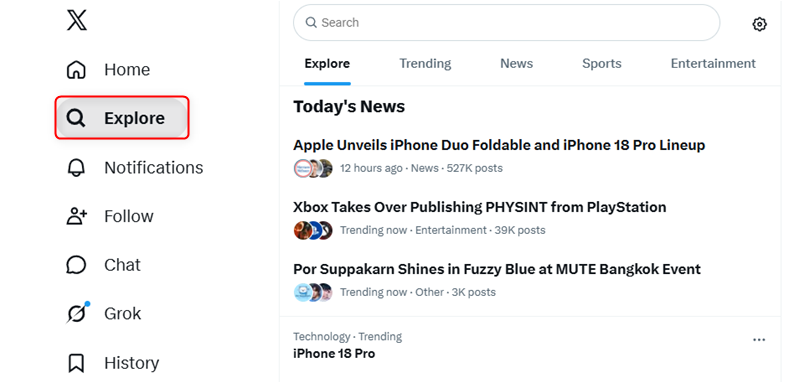
For ongoing research, AllyHub can strengthen the second and third sources. Its Radars track keywords, news, and selected X accounts, while Creator Watch analyzes creator performance, viral posts, positioning, and successful content patterns. AllyHub can also summarize emerging trends and turn them into content ideas. Use these insights to spot potential hashtags, then validate each tag directly on X before adding it to your bank.
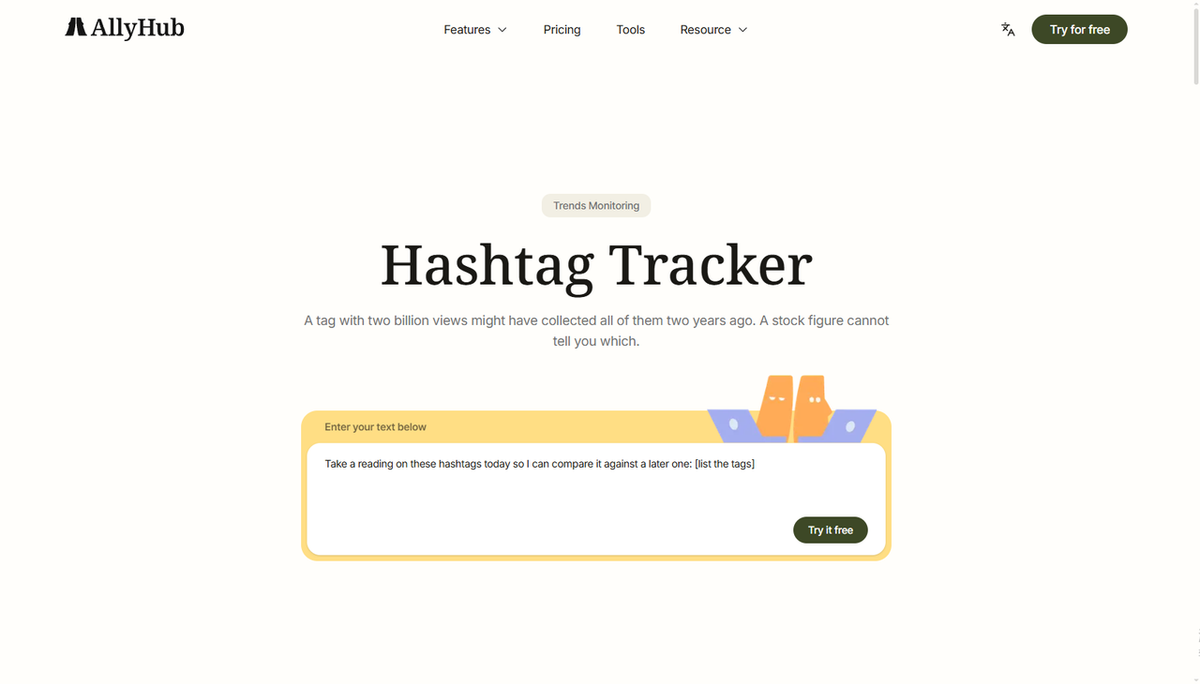
Try it with AllyHub
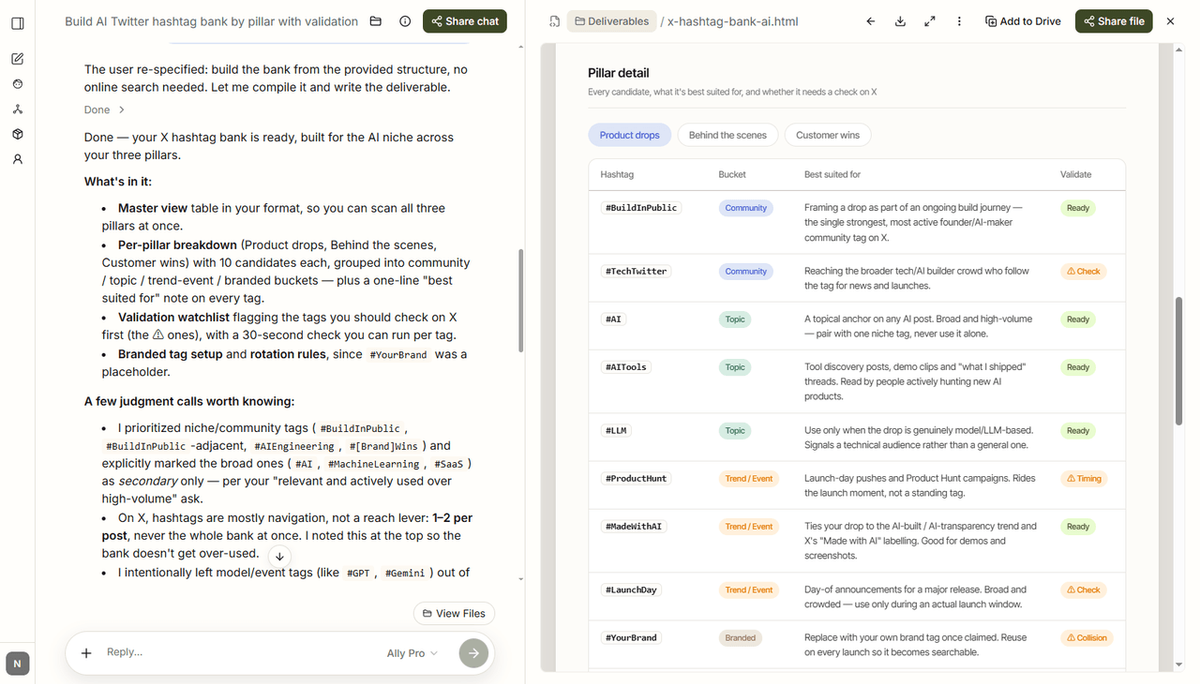
Use this prompt in AllyHub to turn creator and trend research into a starting hashtag list:
Research X hashtags for [topic/niche]. Monitor relevant keywords and X accounts in my niche, identify recurring hashtags and emerging topics, and analyze which content patterns are gaining traction. Group the findings into: (1) broad hashtags, (2) niche-specific hashtags, and (3) emerging or community hashtags. For each candidate, explain why it may be relevant and suggest the type of post it fits. Do not assume popularity equals relevance; flag candidates that need manual validation on X.
Step 3: Build a tag bank around your content pillars
Decide tags post-by-post is how people end up hashtag-stuffing. Instead, define your 3–5 content pillars and sort candidates into buckets — community tags, topic tags, trend/event tags, and branded tags. Keep the bank as plain text next to each pillar in your notes app:
- Creator tips → #ContentCreator (community) · #SocialMediaTips (topic)
- Behind-the-scenes → #ContentCreator (community) · #BehindTheScenes (topic)
- Content strategy → #ContentCreator (community) · #ContentStrategy (topic)
Refresh it quarterly — tags fall out of use fast.
Step 4: Apply the rules that keep you out of the spam bucket
One or two relevant hashtags per post performs best, while three or more can trip spam filters and cut engagement, and X's ranking signals weight post quality over tag volume. Put tags at the end of the post, never mid-sentence. Mix one community tag with one topic tag, and rotate pairs so you're not copying the same combination onto every post. Capitalize multi-word tags (#SmallBizTwitter) so they're readable. And keep hashtags out of any boosted ads — X banned them from paid ads in June 2025.
💡 Pro tip: If you manage several accounts (MCNs and new media operators, this means you), duplicate the bank per account with a "last used" column so tags stay varied across your feeds.
Step 5: Measure monthly, then prune
Each month, run two comparisons: posts with tags vs. posts without, then tag A vs. tag B on similar content. For the second comparison to be meaningful, the posts need to be close in format, timing, and topic — otherwise you're measuring the post, not the tag.
If you've connected your X account to AllyHub Social, the performance data is already pulled in. Use the built-in AI analysis to identify which content types are gaining traction, then cross-reference with the hashtags you used on those posts.
Your situation | Recommended setup |
Solo creator posting daily | 1 community tag + 1 topic tag at the end, rotated from your bank |
Faceless/UGC creator building channels | Community tag only; save the second slot for trends you can genuinely join |
MCN or agency managing accounts | Per-account banks + quarterly audits; standardize the process, vary the tags |
The Best Hashtags for X (Twitter): Updated September 2026
The tags below were active and healthy when this update went out in September 2026 — spot-checked on X. Treat them as a starting bank, run the Step 1 audit on anything you adopt, and always follow the 0–2 rule from Method 4.
For Creators and Content Brands
The creator community on X runs on a set of tags that reliably surface collaboration, feedback, and audience conversations:
- #ContentCreator and #CreatorsOfTwitter — the general home tags for people making content on X; use them when sharing process, milestones, or creator-specific lessons.
- #WritingCommunity — the strongest long-running creative community tag; active daily for writers, scripters, and faceless content brands.
- #UGC and #UGCCreator — increasingly active as brands hunt for user-generated content talent; useful for UGC creators positioning themselves to be found.
- #BuildInPublic and #IndieHackers — the solo-builder corner: launches, metrics, and honest breakdowns. Ideal for solo creators and indie operators.
For Small Business and E-commerce Sellers
Buyers on X rarely search "buy my product," but they do search and browse these communities:
- #SmallBizTwitter and #SmallBusiness — where business owners and local supporters gather; pair with behind-the-scenes or founder-story content.
- #ShopSmall and #SupportSmallBusiness — seasonally powerful (November through the holidays) and still active year-round for product posts.
- #EcommerceTips and #OnlineBusiness — topic tags that reach fellow sellers and operators; good for how-to content that builds authority.
- #ProductLaunch — event-style tag for drops and launches, especially when combined with a live thread.
For Marketing Operators, MCNs, and Agencies
If you're marketing on X or marketing a marketing brand:
- #MarketingTwitter — the flagship marketing community on X; active daily with genuine discussion, not just promotion.
- #ContentMarketing, #DigitalMarketing, and #SocialMediaMarketing — solid topic tags for strategy posts and industry commentary.
- #MarketingTips — a high-volume topic tag; audit it first, as volume attracts noise.
Trending Themes for Late 2026
Some themes deserve a slot in your bank because they keep producing conversations:
- AI and tech — #AI, #ArtificialIntelligence, #TechTwitter, and #MachineLearning remain among the most consistently active topic areas on X through 2026; ideal for faceless creators covering AI news and tools.
- Weekly ritual tags — #WorkoutWednesday, #FoodieFriday, #TravelTuesday, #MotivationMonday still run on schedule; slot them in only when a post genuinely fits the ritual.
- September seasonal tags — #HelloSeptember, #SeptemberGoals, #BackToSchoolSeason, and #FallIsComing are active now but fade fast; treat them as this month's trend slot, not a permanent bank entry.
⚠️ Warning: "Trending" is not the same as "relevant." Jumping on a viral tag with unrelated content is the fastest way to get ignored — or flagged. Use trend tags only when your post genuinely belongs to that conversation.
FAQ
How do I find the hashtags my competitors are actually using?
The most reliable method is to manually review their top-performing posts on X. For a more systematic approach, AllyHub's Creator Watch radar tracks selected accounts and surfaces recurring hashtags and content patterns — useful when you're monitoring multiple creators in your niche.
Can I use hashtags in X replies?
Yes, but don't rely on them as a major discovery tactic. Hashtags in replies are searchable, but the reply still depends heavily on the visibility of the original conversation. Use hashtags primarily when they add genuine context to the reply.
Can I use the same hashtags on X, TikTok, and Instagram?
You can, but the strategy should not be identical. Each platform has different hashtag conventions and discovery systems. On X, keep hashtags limited and closely related to the topic rather than copying a longer TikTok or Instagram hashtag set.
Why isn't my hashtag showing up in X search?
Check that the hashtag is formatted correctly: it needs a # directly before the word or phrase, with no spaces or punctuation breaking it. X may also filter some posts from search based on account, content, or search-quality signals.
Can I create my own hashtag on X?
Yes. Anyone can create a hashtag simply by adding # before a word or phrase. A branded hashtag is most useful for organizing a recurring campaign, series, or community conversation; creating the tag alone won't make it popular.